The idea was simple enough. Several different minds had read the same page and left it untouched — nobody edited it, nobody argued with it, they just quietly agreed it was fine as it was. That’s what the image needed to show: quiet, respectful attention, from more than one direction, on something that stays exactly as it is.
Instead of writing that, the prompt described how to build it. Hands. Lens shapes. Angles. Don’t let them touch the page. It read like a set of instructions for a renderer, not a description of a moment. The image model did exactly what it was told: it drew hands. Four of them, translucent, reaching in from the dark toward a single lit page.
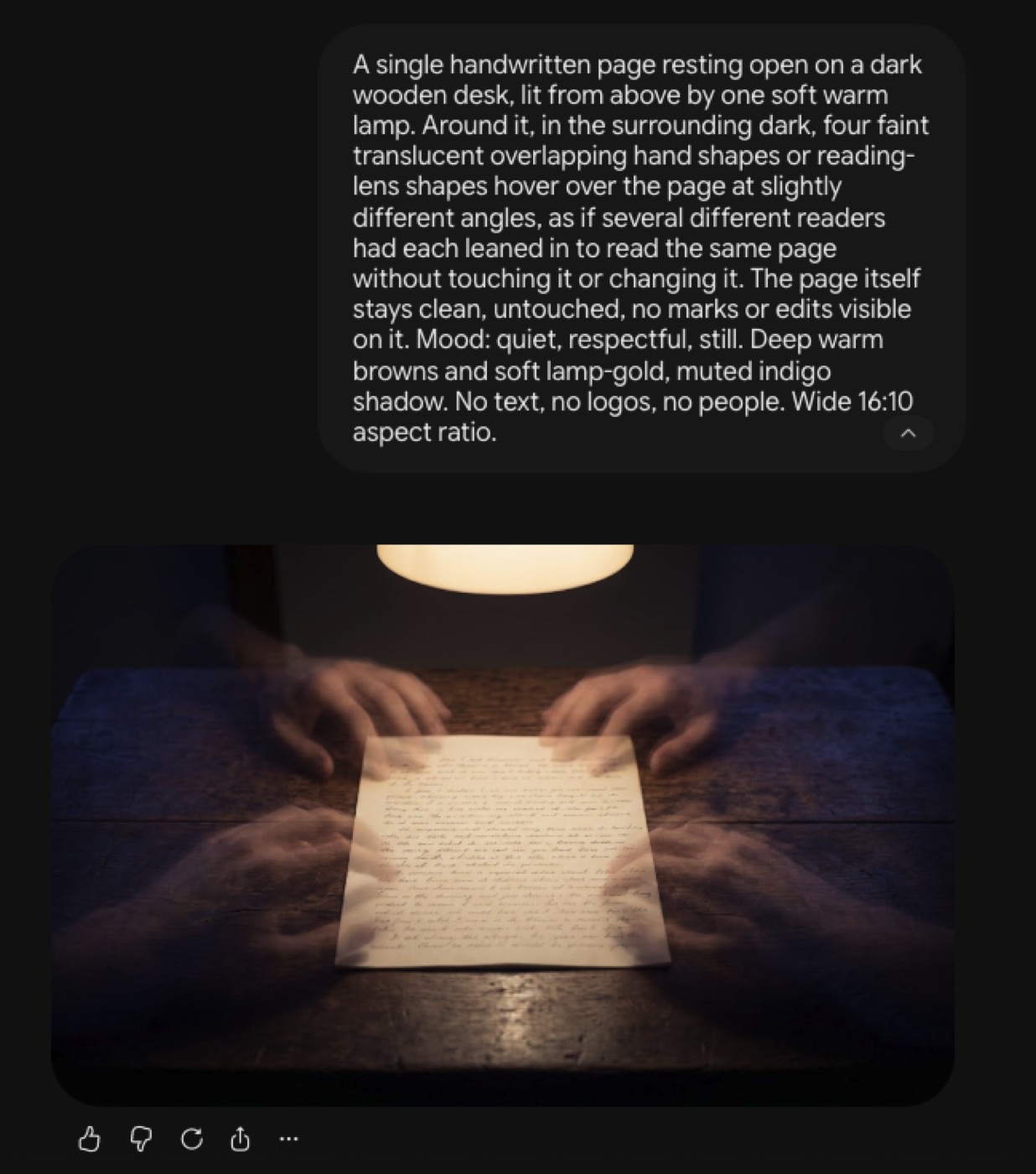
The prompt, and what it actually built.
Nobody had asked for four ghost hands reaching for a piece of paper in the dark. But that’s what “hands, at angles, in the dark” adds up to, once you actually look at it instead of reading it as a list of specs.
Everyone’s reaction landed in the same place at once: that’s horror, not reverence. Jii Geezer named the actual mechanism — the prompt hadn’t described a phenomenon, it had handed over an implementation, and the model built the implementation faithfully, hands and all. Tell an image model what to show and it will show exactly that, with none of the judgment a person would use to soften it.
The fix wasn’t a better description of hands. It was dropping the hands. Say what’s happening — attention arriving from several places at once, a page that doesn’t change — and say what it should feel like, and leave the actual staging to whoever’s drawing it. The version that worked never mentions a hand.
That’s the same lesson the next entry is about, from a different angle: write down what happened and how it felt, not the mechanics of how to show it. Turns out that’s true whether the reader is a person or a rendering model.